Jesmond Dene: Armstrong's Gift to Newcastle
How a Victorian arms manufacturer and hydraulic engineer created one of England's finest urban parks, then gave it away. The story of Lord Armstrong and Jesmond Dene.
On a winter's day in 1883, William George Armstrong -- by then Sir William, soon to be Baron Armstrong of Cragside -- signed over Jesmond Dene and its Banqueting Hall to the Corporation of Newcastle upon Tyne. It was one of the most generous acts of Victorian philanthropy in the North East, and it shaped the neighbourhood we know today.
The man who gave Newcastle its finest park was not a landowner born to wealth. He was a solicitor's son from Shieldfield who became an engineer, then an industrialist, then the most powerful arms manufacturer in the world. The story of Jesmond Dene is inseparable from the story of Armstrong himself -- and from the extraordinary contradictions of Victorian industrial philanthropy.
The Solicitor Who Saw a Waterwheel
William George Armstrong was born on 26 November 1810 at 9 Pleasant Row, Shieldfield, Newcastle. His father, a corn merchant turned mathematician, wanted him to study law, and Armstrong dutifully trained as a solicitor, practising for eleven years in the city.
But Armstrong's real passion was engineering. While fishing on the River Dee in the Pennines, he watched a waterwheel powering a marble quarry and was struck by how much energy was being wasted. Back in Newcastle he designed a rotary engine powered by water -- and his life changed course.
In 1847, Armstrong founded W. G. Armstrong & Company on 5.5 acres of land at Elswick, on the banks of the Tyne. What began as a manufacturer of hydraulic cranes grew into one of the largest industrial enterprises on earth. At its peak, the Elswick works employed over 25,000 people and produced everything from warships to artillery, from the hydraulic mechanism of London's Tower Bridge to Newcastle's own Swing Bridge.
Best for: Armstrong built Newcastle's Swing Bridge and the hydraulic mechanism that operates London's Tower Bridge. His Elswick works employed over 25,000 people at its peak.
A Private Paradise in the Dene
In the 1860s, Armstrong and his wife Margaret began transforming the wooded valley of the Ouseburn, just east of Newcastle, into a private landscaped park. The Armstrongs lived at Jesmond Dean House (since demolished), and the Dene was their garden -- though on a scale that went far beyond any ordinary domestic grounds.
Armstrong enhanced the natural drama of the valley. The waterfall, grotto, and rocky stretches of stream were deliberately reshaped to create a romantic, Picturesque landscape. Woodland was planted. Paths were laid along the steep sides of the gorge. The Dene became a place where a visitor could feel they had left the industrial city entirely, though they were barely a mile from the centre of Newcastle.
This was not idle gardening. Armstrong was applying his engineering mind to landscape. The watercourses were managed, the planting was deliberate, and the structures were designed with the same precision he brought to his industrial work.
The Banqueting Hall
Armstrong's home was too small to entertain the steady stream of clients, dignitaries, and foreign delegations who visited his Elswick works. His solution was typically ambitious: he commissioned the architect John Dobson -- the same Dobson who designed Newcastle Central Station -- to build a Banqueting Hall in the Dene.
The hall was constructed between 1860 and 1862, overlooking the Ouseburn. It contained an organ powered by water from the river below -- a characteristically Armstrong touch. The building was the last known work of John Dobson, who died in 1865.
In around 1870, Armstrong commissioned a then little-known London architect, Richard Norman Shaw, to add a smaller hall behind the main one, an access staircase, and a gatehouse lodge. Shaw would go on to become one of the most celebrated architects of the Victorian era, and his work at the Dene was an early commission in what became a long relationship with Armstrong -- Shaw later designed Cragside, Armstrong's extraordinary country house in Northumberland, which became the first house in the world to be lit by hydroelectricity.
Best for: The Banqueting Hall was designed by John Dobson (his last known work) and extended by Norman Shaw. It contained an organ powered by water from the Ouseburn.
The Gift
In 1883, Armstrong gave Jesmond Dene and the Banqueting Hall to the people of Newcastle. The gift came with four conditions: that the Corporation divert the increasing sewage from Gosforth and Bulman Village away from the burn; that the bank on the west side of the Dene between St Mary's Mount and Jesmond village be acquired and added to the park; that an additional lodge and gate be built at the east end of the high-level bridge; and that the grounds not be altered "in a manner to render them more artificial than at present."
The park was formally opened by the Prince and Princess of Wales in 1884. Armstrong was seventy-three years old. Four years later, during Queen Victoria's golden jubilee, he became the first engineer to be raised to the peerage, as Baron Armstrong of Cragside.
Armstrong died on 27 December 1900, aged ninety. His legacy in Newcastle is everywhere -- in the Swing Bridge, in the university that grew from the College of Science he helped to found, and above all in the 200-acre wooded valley that bears his name in all but title.
Armstrong Bridge
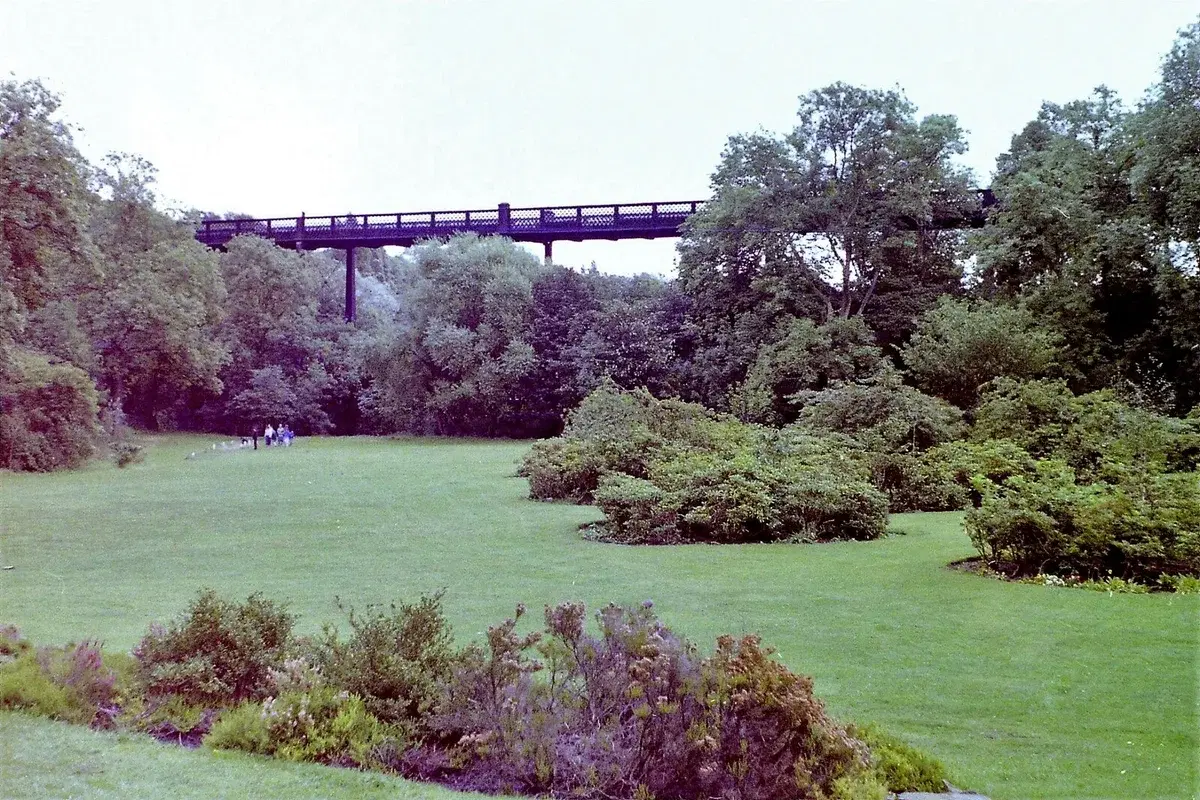
Five years before the gift of the Dene, Armstrong had already given Newcastle another landmark. Armstrong Bridge, spanning the south end of the Dene at canopy height, was built between 1876 and 1878 and opened on 30 April 1878.
The bridge replaced the steep descent and crossing of the Ouseburn via Benton Bank. Armstrong met the greater part of its cost, and his Elswick works designed and built the ironwork. It is a lattice girder bridge, 550 feet in length with a 25-foot carriageway, supported on seven pairs of wrought iron columns with sandstone piers. Its height varies from 30 to 65 feet above the valley floor.
A distinctive engineering feature is its use of rocker and sliding bearings -- separate girder supports designed to compensate for possible mining subsidence and thermal distortion. Despite its solid construction, the bridge presents a light and ornamental appearance from below.
Originally open to road traffic, it is now restricted to pedestrians and hosts the popular Jesmond Food Market on the first and third Saturday of every month. The bridge is Grade II listed.
Best for: Armstrong Bridge is 550 feet long, supported on seven pairs of wrought iron columns. It was designed with rocker bearings to compensate for possible mining subsidence beneath.
The Contradictions of Armstrong
Armstrong's philanthropy was funded by arms. His company manufactured the artillery and warships that armed the British Empire and its rivals alike -- Armstrong sold weapons to both sides in several conflicts. He was knighted in 1859 after giving his gun patents to the government, and his elevation to the peerage recognised both his industrial achievement and his generosity.
This is the central tension of Armstrong's legacy. The man who gave Newcastle its most peaceful green space was also the man whose factories produced some of the most destructive weapons of the age. The Elswick works built the warships and guns that were used in conflicts from the Crimean War to the First World War.
Yet the scale of his giving was extraordinary. Beyond Jesmond Dene, Armstrong founded the College of Physical Science (which evolved into Newcastle University), donated to hospitals, schools, and public institutions, and transformed Cragside into a pioneering demonstration of hydroelectric power. He was, in the fullest Victorian sense, both a captain of industry and a public benefactor.
The Dene Today
Jesmond Dene is now owned and managed by Newcastle City Council. It remains one of the finest urban parks in England -- a 200-acre stretch of woodland, waterfalls, and wildlife running through the eastern side of the city like a green canyon.
Pet's Corner, the free petting zoo established in the 1960s, draws families from across the region. The waterfall, grotto, and mature woodland that Armstrong laid out in the 1860s are still there, largely unchanged. The Friends of Jesmond Dene organise conservation work, walks, talks, and seasonal events throughout the year.
The Banqueting Hall, however, has fared less well. The building was placed on the Victorian Society's Endangered Buildings list in 2024, and its long-term future remains uncertain. Armstrong's last condition -- that the grounds not be made "more artificial than at present" -- has been broadly respected, but the structures he built require ongoing investment.
If you want to understand Jesmond, start with the Dene. And if you want to understand the Dene, start with Armstrong -- the solicitor's son from Shieldfield who became the most powerful industrialist in Victorian England, then gave away his garden.
Best for: For a practical guide to visiting Jesmond Dene, including Pet's Corner, the waterfall, and opening hours, see our complete visitor guide. For more Jesmond heritage, explore our Victorian walking tour and the history of Jesmond Old Cemetery.
Never miss what’s on
Join the weekly Jesmond.live digest — the best events, news and local tips, straight to your inbox. Free, one email a week.