Jesmond Old Cemetery: A History of Newcastle's Victorian Resting Place
Designed by John Dobson, home to the Bainbridges, Hancocks, and Fenwicks, the remarkable history of Jesmond Old Cemetery.
Tucked between Jesmond Road and the residential streets to its west, Jesmond Old Cemetery is one of Newcastle's most historically significant burial grounds. Founded in 1834 and still managed today as a nature reserve, it contains the graves of some of the most important figures in the city's Victorian history, including the architect who designed it.
Here is the story of how it came to be, who rests there, and what you can see today.
Origins
Jesmond Old Cemetery was established in 1834 as a response to the overcrowding of Newcastle's parish churchyards. The western half of the site was consecrated in 1836, and the first burial took place on 16 December 1836, that of Margaret Redford Hoy, the 14-year-old daughter of a local grocer. It is a poignant beginning to a place that would become the resting place of industrialists, architects, and naturalists.
The cemetery was designed by John Dobson, the architect whose work defined Victorian Newcastle. Dobson is best known for Newcastle Central Station, one of the finest railway stations in Britain, but his influence extends across the city, and Jesmond Old Cemetery was one of his commissions. The layout reflects the Victorian ideal of a cemetery as a landscaped park: a place for contemplation and promenading as much as for burial.
Best for: Designed by John Dobson and opened in 1836. The first burial was a 14-year-old girl named Margaret Redford Hoy.
The Architect in His Own Cemetery
John Dobson is not merely the designer of Jesmond Old Cemetery, he is also buried there. Dobson died in 1865 and was laid to rest in the grounds he had planned three decades earlier. It is a fitting resting place for the man who shaped so much of Newcastle's built environment, from the Central Station to the streets and crescents of Grainger Town.
His grave is one of the cemetery's most visited, though it is more modest than you might expect for an architect of his stature. The Victorians were not always ostentatious in death.
Best for: John Dobson designed the cemetery and is buried in it, one of only a handful of architects anywhere to rest in their own creation.
Notable Burials
The cemetery reads like a roll call of Victorian Newcastle. Among the most notable burials are:
-
Emerson Muschamp Bainbridge, founder of Bainbridge's department store on Market Street, widely considered one of the world's first department stores. Bainbridge opened his drapery shop in 1838, and it grew into a Newcastle institution that survived until its absorption into the John Lewis Partnership.
-
Albany Hancock, one of the leading naturalists of the 19th century, known for his pioneering work on marine invertebrates. Hancock collaborated with Charles Darwin and was a Fellow of the Royal Society.
-
John Hancock, Albany's brother and a distinguished ornithologist and taxidermist. The Hancock Museum (now the Great North Museum: Hancock) was named in his honour, and his collection of preserved birds and animals formed the basis of its natural history displays.
-
Members of the Fenwick family, founders of the Fenwick department store on Northumberland Street, still Newcastle's most prominent department store today.
-
Members of the Deuchar, Dove, and Pumphrey families, prominent names in Newcastle's brewing, legal, and Quaker business communities.
The concentration of influential Victorians in a single cemetery reflects Jesmond's status in the 19th century as the neighbourhood of choice for Newcastle's professional and mercantile classes.
Listed Buildings and Monuments
The cemetery contains two Grade II listed buildings and seven Grade II listed monuments, reflecting the architectural quality of its Victorian structures. The entrance lodges, boundary walls, and a number of the grander memorials have statutory protection, ensuring their preservation.
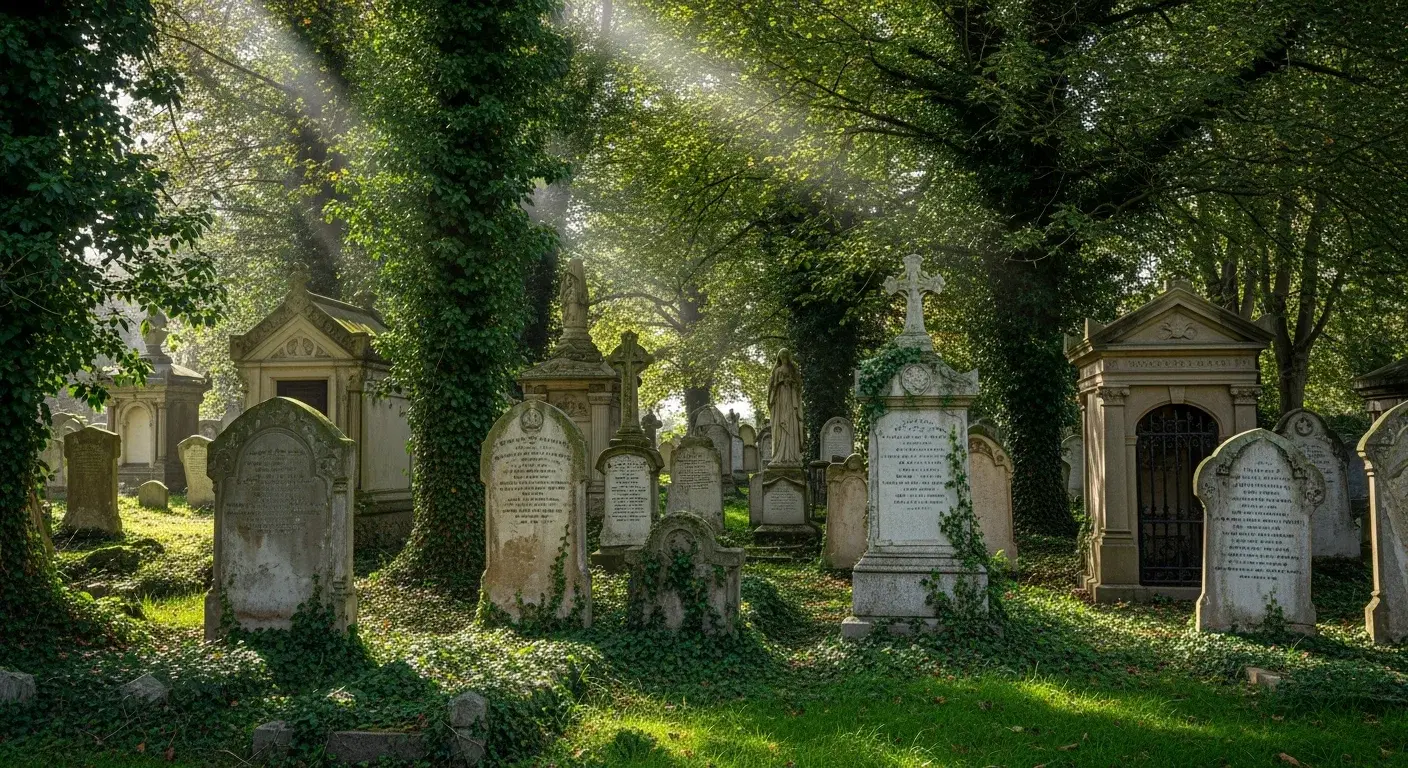
The monuments range from plain headstones to elaborate Gothic and classical memorials, obelisks, draped urns, Celtic crosses, and chest tombs. They are a catalogue of Victorian funerary taste, and collectively they give the cemetery much of its atmospheric character.
Best for: Two listed buildings and seven listed monuments. The Victorian funerary architecture is a reason to visit in its own right.
Commonwealth War Graves
Among the Victorian memorials are 10 Commonwealth war graves, eight from the First World War and two from the Second. These are maintained by the Commonwealth War Graves Commission and are marked with the Commission's distinctive white headstones.
The war graves are a quiet reminder that the cemetery's story extends well beyond the Victorian era. Young men from Jesmond and the surrounding streets are buried here alongside the industrialists and professionals of an earlier generation.
The Cemetery Today
Jesmond Old Cemetery is no longer used for new burials. Instead, it is managed as a nature reserve, and the shift from manicured graveyard to semi-wild green space has given it a distinctive character. Mature trees, wildflowers, and overgrown paths wind between the headstones, creating a habitat for birds, insects, and small mammals.
The combination of Victorian architecture and natural woodland makes the cemetery one of Jesmond's most atmospheric places to visit. It is peaceful, slightly wild, and full of history, a place where you can read the stories of the people who built Victorian Newcastle while listening to birdsong overhead.
The cemetery is on Jesmond Road, easily reached on foot from Jesmond Metro station or by bus along the main road.
Best for: Now a nature reserve. Wildflowers and birdsong among the Victorian headstones, one of Jesmond's most atmospheric spots.
Visiting
The cemetery is open daily and free to enter. There are no formal facilities, no café, no visitor centre, but the paths are accessible and the site is well signposted. A slow circuit of the grounds takes around 30 to 45 minutes, longer if you stop to read the inscriptions.
For those interested in Newcastle's Victorian history, Jesmond Old Cemetery is one of the essential sites. The stories carved into its headstones, of architects, department store founders, naturalists, and ordinary families, are the stories of the city itself.
Have a suggestion? Get in touch.
Never miss what’s on
Join the weekly Jesmond.live digest — the best events, news and local tips, straight to your inbox. Free, one email a week.