A Heritage Walking Trail Through Jesmond
A self-guided heritage walk through Jesmond, linking a medieval pilgrim chapel, Lord Armstrong's wooded dene, a Grade I church, a Victorian cemetery and a former railway station now serving pints.
Jesmond wears its history quietly. Behind the busy bars and brunch spots of Osborne Road lies one of the oldest place names in Newcastle, a medieval pilgrimage site, a wooded valley shaped by one of the great Victorian industrialists, and a scattering of grand buildings that tell the story of the merchants and engineers who made the suburb their home.
This self-guided trail covers roughly 3 miles and takes about two hours at a gentle pace. It runs broadly north through the neighbourhood, beginning near Jesmond Metro station and ending close to West Jesmond, so you are rarely far from a cafe, a pub or a Metro stop if you want to shorten it. The pavements along Osborne Road and Jesmond Road are flat and fully accessible, but the Jesmond Dene section includes slopes, steps and paths that can be muddy after rain.
Best for: Allow around two hours for the full trail. The street sections are flat and buggy-friendly; the paths through Jesmond Dene are more uneven and can be slippery in wet weather.
Stop 1: Jesmond Old Cemetery
Begin near Jesmond Metro station at Jesmond Old Cemetery, off Jesmond Road. Opened in 1836 as the Newcastle General Cemetery, it was designed as a dignified alternative to the city's overcrowded churchyards. The imposing entrance archway and its flanking chapel lodges were the work of John Dobson, the architect who did more than anyone to shape Georgian and Victorian Newcastle.
Sometimes called "the Highgate of the North", the cemetery is the resting place of many of the people who built the modern city, including Dobson himself, the department-store founder Emerson Muschamp Bainbridge, and the celebrated naturalist Albany Hancock. It is a peaceful, atmospheric place to begin, and the listed gatehouse alone is worth a few minutes before you move on.
Stop 2: Church of St George
Walk north up Osborne Road and you cannot miss the 154-foot campanile of St George's Church, deliberately modelled on the bell tower of St Mark's in Venice. Consecrated in 1888, the church was designed by Thomas Ralph Spence and paid for by Charles Mitchell, the Tyneside shipbuilder and business partner of Lord Armstrong.
It is an extraordinary building for a suburban parish. Unusually for a lesser-known architect working outside London, St George's Church Jesmond is Grade I listed and widely regarded as Spence's masterpiece. Step inside if it is open to see the richly decorated interior, with Italianate mosaics, a marble altar and stained glass installed when the church was new.
Best for: St George's is an active parish church, so opening times vary. The exterior and its landmark tower can be admired from Osborne Road at any time.
Stop 3: Jesmond Dene and St Mary's Chapel
From Osborne Road, make your way east towards Jesmond Dene, the wooded valley of the Ouseburn that gives the suburb much of its character. Near the southern end of the dene stand the ruins of St Mary's Chapel, the oldest structure on the whole trail.
The name Jesmond is thought to derive from "Jesus mound", and in the medieval period the chapel and its nearby holy well drew pilgrims from across the country. First recorded in the thirteenth century, it was one of the more important pilgrimage destinations in medieval England. The chapel fell into ruin after the Reformation, but the stone shell survives, and an annual open-air service is still held among the ruins to this day.
Stop 4: The Old Mill and Pets' Corner
Head deeper into the dene to find the Old Mill, a picturesque stone building with its great wooden water wheel now stilled. A mill has stood on this stretch of the Ouseburn for centuries; the current ruin was preserved not for industry but as a romantic feature in the landscape Lord Armstrong created.
The dene you walk through today was largely the creation of William Armstrong, the engineer, inventor and armaments manufacturer, and his wife Margaret. From the 1850s they bought up the valley and remodelled it with footpaths, weirs, waterfalls and thousands of trees. In 1883 Armstrong gave Jesmond Dene to the people of Newcastle as a public park, and it has remained free to enter ever since. Nearby you will find Pets' Corner, a free-entry animal centre that has delighted families since the 1960s.
Stop 5: Armstrong Bridge
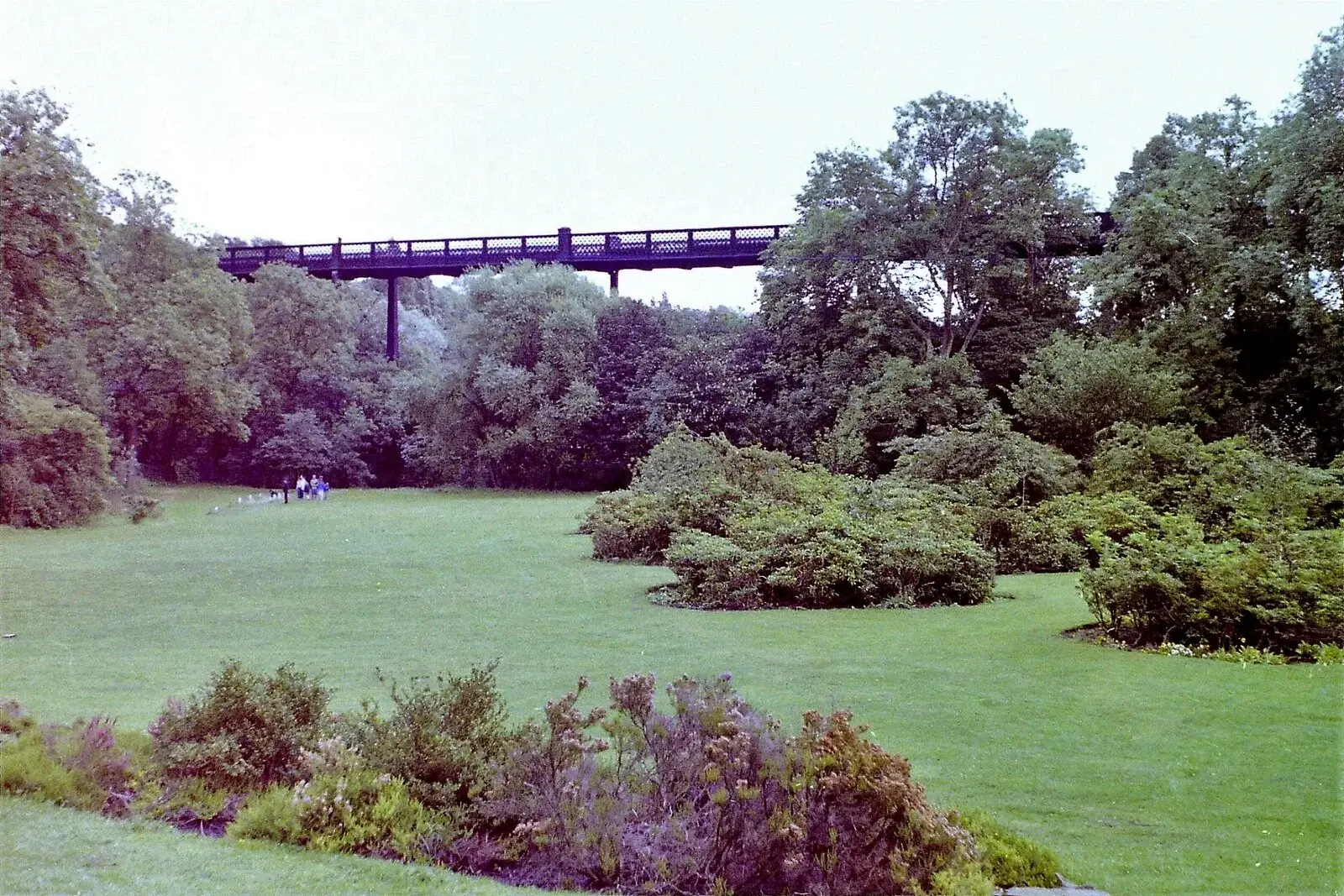
Continue south through the valley to reach Armstrong Bridge, the elegant iron span that crosses the dene high above the Ouseburn. Opened in 1878, it was designed and built by Armstrong's own Elswick works and largely paid for by him, replacing an awkward crossing at Benton Bank.
The bridge has a clever engineering trick built in: its rocker and sliding bearings were designed to absorb the movement caused by mining subsidence and temperature change, a neat expression of Armstrong's engineering mind. Now closed to traffic, it hosts a popular arts and crafts market most Sunday mornings, making it a lively spot to pause.
Stop 6: Jesmond Dene House
A short walk brings you to Jesmond Dene House on Jesmond Dene Road, now a boutique hotel and restaurant but originally one of the grand private homes of Armstrong's circle. In 1871 it was bought by Captain Andrew Noble, a partner in Armstrong's shipbuilding and armaments firm.
Noble commissioned the leading Arts and Crafts architect Norman Shaw, working with local architect Frank West Rich, to roughly double the size of the house, adding a west wing, a great hall and a Gothic porch. The result is a fine Grade II listed Arts and Crafts building overlooking the wooded valley, and even if you are not staying or dining it is worth admiring from the road.
Stop 7: The Carriage
Leave the dene and head towards Jesmond Road to reach The Carriage, a pub with an unusually literal name. The building was the original Jesmond railway station, opened in 1864 on the Blyth and Tyne Railway's line into Newcastle and built in a Tudor style, possibly to designs by John Dobson.
The station closed in 1978 when the line was converted for the Tyne and Wear Metro, and the underground Jesmond Metro station replaced it a short distance away. The old station buildings survive as the last of the Blyth and Tyne stations still standing, now Grade II listed. Inside the pub you can still spot relics of its railway past, including the old ticket booth, an adjoining carriage and a signal box.
Stop 8: Jesmond Towers
Finish the trail by walking north-west towards West Jesmond and Jesmond Towers on Bemersyde Drive. This sprawling mansion began as an early nineteenth-century house for Sir Thomas Burdon, a mayor of Newcastle, and was greatly enlarged in the 1860s and 1880s by Charles Mitchell, the same shipbuilder who paid for St George's Church.
After the Mitchell family left, the house was bought in 1912 by the Daughters of Wisdom and became La Sagesse convent and Roman Catholic school, which occupied the building until 2008. Now Grade II* listed and converted back to private use, Jesmond Towers is a fitting final stop, tying together the merchant wealth, faith and grand architecture that run through the whole walk.
Practical Information
| Detail | Information |
|---|---|
| Distance | Approximately 3 miles (4.8 km) |
| Time | Around 2 hours |
| Terrain | Flat, paved streets plus uneven valley paths in Jesmond Dene |
| Start | Jesmond Old Cemetery, near Jesmond Metro station |
| End | Jesmond Towers, West Jesmond |
| Transport | Jesmond and West Jesmond Metro stations bookend the route |
| Refreshments | Cafes and pubs on Osborne Road; The Carriage and Jesmond Dene House |
| Accessibility | Street sections buggy and wheelchair friendly; the dene has slopes and steps |
Never miss what’s on
Join the weekly Jesmond.live digest — the best events, news and local tips, straight to your inbox. Free, one email a week.
What's On
Relaxed Early Opening at the Great North Museum: Hancock
9:00 AM - 10:00 AM · Great North Museum: Hancock, Barras Bridge, Newcastle upon Tyne, NE2 4PT
LEGO Build the Change: Drop-in Mass Build
10:30 AM - 3:00 PM · Great North Museum: Hancock, Barras Bridge, Newcastle upon Tyne, NE2 4PT
Art Armada Youth Art Workshop for GCSE and A Level Students
12:00 PM - 3:30 PM · Sid Chaplin Room, Jesmond Library, St George's Terrace, Newcastle upon Tyne, NE2 2DL