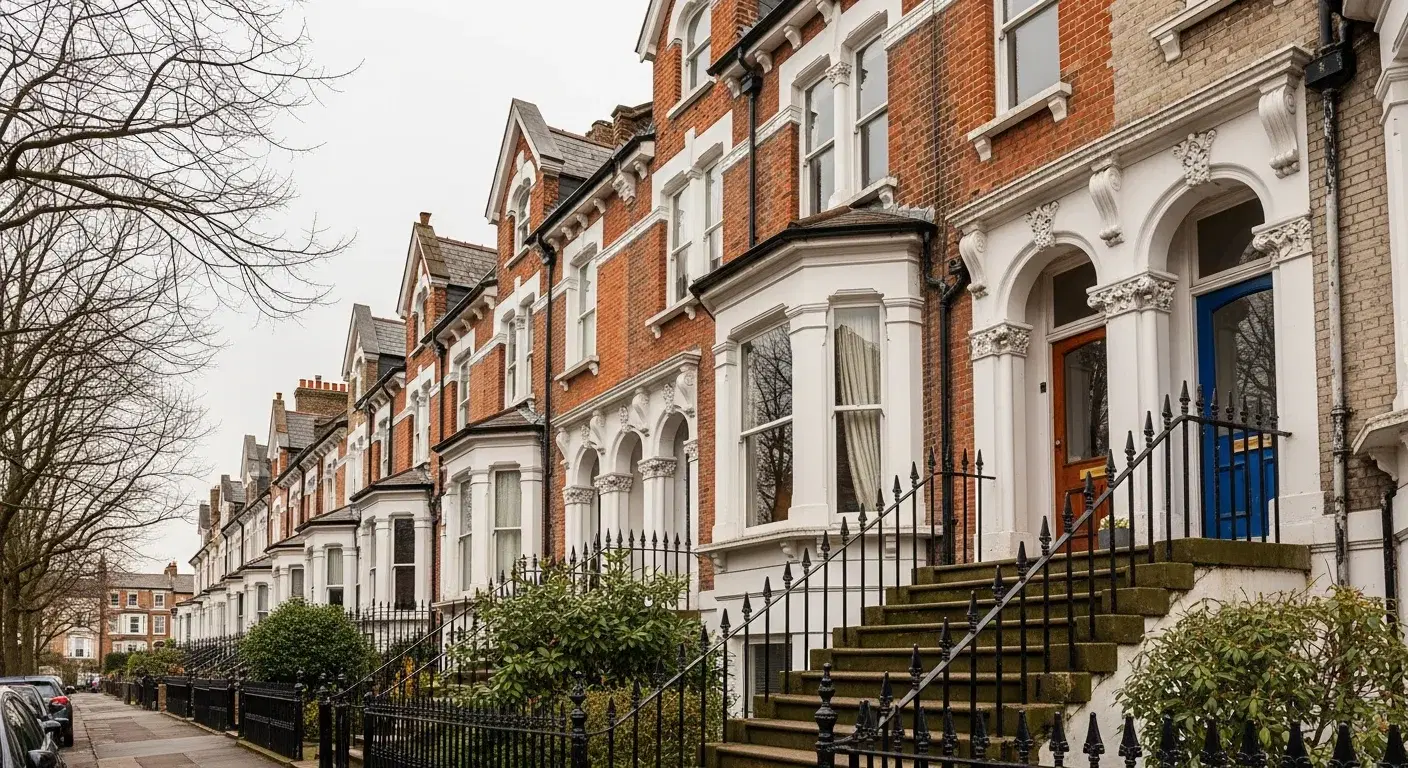
Jesmond's Victorian and Edwardian Architecture
Grand villas, Arts and Crafts terraces, and Queen Anne red brick -- how Newcastle's Victorian wealthy built their suburb in Jesmond, and what survives today.
Walk any street in Jesmond and you are walking through a Victorian building site that never quite stopped. Almost everything you see -- the bay windows, the sandstone lintels, the cast-iron railings, the tree-lined avenues -- dates from a single extraordinary burst of construction between the 1860s and the early 1900s, when speculative builders transformed open farmland into Newcastle's most desirable residential suburb.
This guide traces the architectural story of Jesmond, street by street, from the earliest terraces to the grandest villas, and follows it through the Edwardian period and into the present day.
Why Jesmond Was Built
Before the 1860s, Jesmond was largely farmland, country estates, and the remnants of medieval settlement. The catalyst for change was the railway. When the Newcastle to Tynemouth line opened through Jesmond in 1864, it became possible for the first time to live in leafy surroundings and commute to central Newcastle in minutes.
The Victorian middle classes seized the opportunity. Shipbuilders, shipowners, industrialists, and the professional class -- the people who were making fortunes from Tyneside's booming economy -- wanted grand houses away from the smoke and noise of the city. Jesmond, with its gentle hills, the wooded valley of the Dene, and its proximity to the town moor, was the obvious choice.
The result was one of the most concentrated episodes of Victorian suburban development anywhere in the North East.
Best for: The builder Pears Archbold was responsible for much of Osborne Road, Portland Terrace, Osborne Terrace, Hutton Terrace, and the villas on Clayton Road, all constructed between 1863 and 1875.
Brandling Village: Where It All Began
The oldest part of Victorian Jesmond is Brandling Village, designated as a conservation area in 1976. Development here began as early as 1820, when terraced cottages were built for employees of the Jesmond coal mines along the High Street. But the real transformation came from the mid-nineteenth century onwards, when the area shifted from a semi-rural settlement to a planned suburb of terraced housing for middle-class families.
Today Brandling Village contains 36 Grade II listed buildings. The architectural character is a mixture of late Georgian restraint and Victorian confidence -- well-proportioned terraces in local stone, with the bay windows and decorative doorways that would become Jesmond's signature.
Eslington Terrace is a particular highlight. The terrace consists of two blocks of six red brick houses, each with a bay window and a crenellated tower at first floor level. These are textbook Arts and Crafts style, and for the most part they are externally unaltered -- a rare survival in a neighbourhood where many houses have been divided into flats.
Best for: Brandling Village Conservation Area contains 36 Grade II listed buildings and was designated in 1976 as an excellent example of a Victorian and Edwardian suburb developed between 1820 and 1920.
Osborne Road and Osborne Terrace
Osborne Road is Jesmond's main street and its commercial spine, but it began life as a residential avenue of considerable ambition. The houses along Osborne Terrace and the streets immediately behind it were among the first to be built during Jesmond's Victorian expansion, many by the builder Pears Archbold from 1863 onwards.
The homes he built here were intended for Newcastle's industrial elite. T.H. Bainbridge of the department store and G.B. Hunter of Swan Hunter shipbuilders were among the early residents. The houses are large, confident, and display the Italianate detailing that was fashionable in the 1860s and 1870s -- tall windows, bracketed eaves, and restrained classical proportions.
Over the decades, many of these houses have been converted to commercial use. The Osborne Hotel is one of several that now serves visitors rather than residents. But the streetscape retains its Victorian scale, and the upper storeys -- where the original stonework, sash windows, and decorative cornices survive -- repay a careful upward glance.
Clayton Road and Fernwood Road: The Villa Streets
Turn off Osborne Road towards Clayton Road and the character shifts from terraced grandeur to something more expansive. Clayton Road, Fernwood Road, and Granville Road are characterised by large detached and semi-detached Victorian villas set in generous plots with mature gardens.
The earliest villas here, dating from the 1860s and 1870s, are in sandstone or buff brick with Italianate elevations -- symmetrical facades, round-headed windows, and low-pitched roofs with overhanging eaves. These are the houses of merchants and shipowners, built to impress.
Later houses on the same streets, dating from the 1880s and 1890s, shift towards the Queen Anne style that was sweeping through fashionable suburbs across England. The hallmarks are red brick rather than sandstone, asymmetrical facades, shaped gables, decorative terracotta panels, and tall chimneys. The effect is warmer and more decorative than the Italianate houses, and the two styles sit side by side along these streets in an accidental but appealing architectural conversation.
Best for: Clayton Road displays a rare timeline of Victorian taste -- from the restrained Italianate sandstone villas of the 1860s to the exuberant Queen Anne red brick of the 1890s, all on the same street.
Brentwood Avenue and Ilford Road: The Grand Terraces
The parallel streets of Brentwood Avenue, Fernwood Avenue, and Ilford Road represent the peak of Jesmond's Victorian terraced housing. These are not modest workers' terraces but tall, three-storey houses with deep bay windows running the full height of the facade, substantial front gardens behind iron railings, and elaborate decorative stonework.
The houses were built for Newcastle's prosperous professional class -- lawyers, doctors, and senior clergymen. The ambition shows in every detail: stained glass fanlights above front doors, decorative terracotta panels set into the brickwork, and chimney stacks that march along the roofline in confident formation.
Brentwood Avenue in particular has retained a remarkable consistency of character, with relatively few replacement windows or pebble-dashed frontages. The generous street widths -- the Victorians planned for light and air -- and the mature plane trees that now tower above the houses add a grandeur that the original builders could only have hoped for.
Jesmond Dene Road: The Mansions
Cross Armstrong Bridge -- the iron bridge built in 1878 by William Armstrong -- and the character shifts again. The houses along Jesmond Dene Road are not terraces but large detached villas, set well back from the road behind mature gardens. These were the homes of Jesmond's wealthiest Victorian and Edwardian residents.
The architectural styles are more varied here than on the terraced streets. Arts and Crafts influences appear in the use of handmade brick, leaded windows, and steeply pitched roofs. Mock-Tudor half-timbering nods to an older England. The occasional house shows classical proportions, with a portico and symmetrical facade.
Jesmond Dene House is the finest example -- a Grade II listed Arts and Crafts mansion dating from the late nineteenth century, now a boutique hotel and restaurant. The building is a masterclass in the style: hand-crafted materials, carefully composed asymmetry, and a relationship with its landscaped setting that the more formal houses elsewhere in Jesmond never achieve.
Best for: Jesmond Dene House is the best-preserved Arts and Crafts mansion in the neighbourhood and one of the finest in the North East. Its gardens overlook Jesmond Dene itself.
Architectural Styles at a Glance
Jesmond's streets are a textbook of Victorian and Edwardian architectural fashion:
- Italianate (1860s-1870s) -- Sandstone or buff brick, symmetrical facades, round-headed windows, bracketed eaves, low-pitched roofs. See Clayton Road and Osborne Terrace.
- Queen Anne (1880s-1890s) -- Red brick, asymmetrical facades, shaped gables, decorative terracotta, tall chimneys. See later houses on Clayton Road and Fernwood Road.
- Arts and Crafts (1890s-1910s) -- Handmade materials, leaded glass, steeply pitched roofs, deliberate asymmetry, connection to landscape. See Eslington Terrace and Jesmond Dene Road.
- Gothic Revival -- Pointed arches, steep gables, and ecclesiastical detailing appear on several Jesmond churches, including Holy Trinity on Jesmond Road, rather than in domestic architecture.
From Family Homes to Student Lets -- and Back
Jesmond's architectural story does not end with the Edwardians. Through the twentieth century, many of the grand family houses were subdivided into flats, and from the 1960s onwards, the arrival of Newcastle's expanding universities turned whole streets into student accommodation.
The conversion was not always sympathetic. Replacement uPVC windows, pebble-dash over original brickwork, and the loss of front garden walls and railings to car parking all took their toll. In some streets, the cumulative effect was enough to blur the Victorian character that had defined the neighbourhood for a century.
The tide has turned. Rising property values, conservation area protections, and a growing appetite for period features have driven a wave of reconversion. Former student houses are being returned to family homes, original fireplaces and cornices are being restored, and Article 4 directions in the conservation areas mean that many of the unsympathetic changes now require planning permission to reverse -- or to repeat.
The result is a neighbourhood in transition, where streets of immaculate Victorian restoration sit alongside houses still wearing their student-let alterations. The direction of travel, though, is clear. Jesmond's Victorian builders would recognise the ambition.
Exploring Jesmond's Architecture
For a walking route through the streets described above, see our Victorian Streets Walking Tour. The walk takes roughly 90 minutes and covers Brandling Village, Clayton Road, Brentwood Avenue, Armstrong Bridge, and Jesmond Dene Road.
For the story of the man who shaped Jesmond's most famous green space, see Jesmond Dene: Armstrong's Gift to Newcastle.
Have a suggestion? Get in touch.
Never miss what’s on
Join the weekly Jesmond.live digest — the best events, news and local tips, straight to your inbox. Free, one email a week.